“Facts do not cease to exist because they are ignored.” — Aldous Huxley
We often catch ourselves scrolling through social media, nodding along to posts that perfectly align with our views. Then suddenly, a contradicting opinion pops up. We roll our eyes, dismiss it as nonsense, and keep scrolling. Quite normal, right? That’s confirmation bias at work. It is a mental filter that colors how we see the world, letting us cozy up to ideas we like while ignoring those we do not. It can be subtle, powerful, and surprisingly persistent.
In this post, we will explore confirmation bias, one of the most common and influential cognitive patterns. It shapes how we think, how we argue, and how we relate to others. We will examine what it is, why it appears so often, and how to recognize and manage it in everyday life.
What Is Confirmation Bias?
Confirmation bias is our tendency to seek out, interpret, and remember information that supports what we already believe, while brushing off anything that challenges it. It is like having a personal support squad in your brain, cheering for your opinions and booing the opposition.
Psychologist Peter Wason first spotlighted this in a 1960 experiment known as the "2-4-6" task. Participants were given the sequence of numbers "2, 4, 6" and asked to guess the rule behind it. Most tested ideas that fit their hunch, such as "even numbers increasing by 2," instead of trying to disprove it with sequences like "1, 3, 5." Wason found that people rarely tried to falsify their hypotheses. The actual rule was “any numbers increasing in value,” but participants often stuck to their assumptions, even when wrong. Sound familiar?
Why Is Confirmation Bias So Common?
This bias thrives in our daily lives and is amplified by the way we interact with modern technology. It often appears in heated debates about politics or investing, where people cling to news outlets that match their views. One widely cited analysis found that individuals evaluating controversial topics consistently favored evidence that confirmed their beliefs (Nickerson, 1998).
It also emerges in the way we form identity groups around shared beliefs, such as “Team Conservative” or “Team Crypto.” These communities bond over common narratives and quickly dismiss the “other side.” The result is an “us versus them” mindset, where alternative viewpoints are often rejected without real consideration.
Another way confirmation bias shows itself is in the habit of stacking evidence. When debating, people tend to build long lists of supportive points—“This is true because of X, Y, Z, and more.” While this feels satisfying and persuasive, it often blinds us to counterarguments that may be just as valid.
The Internet’s Role: Algorithms and Echo Chambers
If confirmation bias had a best friend, it would be the internet. Platforms like Twitter and Facebook use algorithms that show us what we are most likely to agree with, keeping us engaged. A person who supports one political side may rarely encounter content from the opposite side. Recent research suggests that users interact more with belief-aligned content, reinforcing selective exposure patterns. This creates a feedback loop. You see what you agree with, so you engage with it. You engage with it, so you see more of it.
Let’s take the idea that “money is evil.” We can find countless stories about greedy billionaires to support this belief. But what about philanthropists funding hospitals or education programs? Algorithms may not prioritize those stories if our clicks suggest we prefer outrage.
The Psychology: Why We Ignore the Truth
When we encounter evidence that challenges our beliefs, our brain performs a kind of “mental trial.” Imagine reading 100 articles saying “rich people are bad,” and then seeing one story about a billionaire saving lives. Your brain might shrug it off. “It’s just one case. I’ve seen plenty of proof I’m right.” This is confirmation bias helping us avoid cognitive dissonance, the discomfort that comes from holding conflicting beliefs.
This mental filter can even influence science. A meta-scientific analysis in recent years found widespread signs of selective reporting in published psychology papers. Cherry-picking results and interpreting data to match a favored hypothesis remain real concerns. If researchers are vulnerable to confirmation bias, what chance do the rest of us have?
How to Fight It
We cannot completely eliminate confirmation bias, but we can learn to manage it. One way is to make a habit of seeking out information that challenges your assumptions. If you believe rewards are better than punishments, for example, read an article that supports the opposite. Even if you do not agree, the practice sharpens your thinking. Another helpful strategy is to diversify your information sources. Following people on social media whose views differ from yours may feel uncomfortable at first, but it builds empathy and provides a more complete perspective.
When facing important decisions, it is also useful to step back and apply a simple tool such as a decision matrix. Listing pros and cons objectively helps reduce emotional bias and ensures you are seeing the full picture. At the same time, practice pausing before you dismiss ideas that feel wrong or triggering. Asking yourself, “Why am I so sure I’m right?” can interrupt the automatic rejection of opposing views. Finally, it is worth testing even your most cherished beliefs. We often treat our ideas as precious, but challenging outdated or flawed assumptions creates space for growth, clarity, and better judgment.
Why It Matters
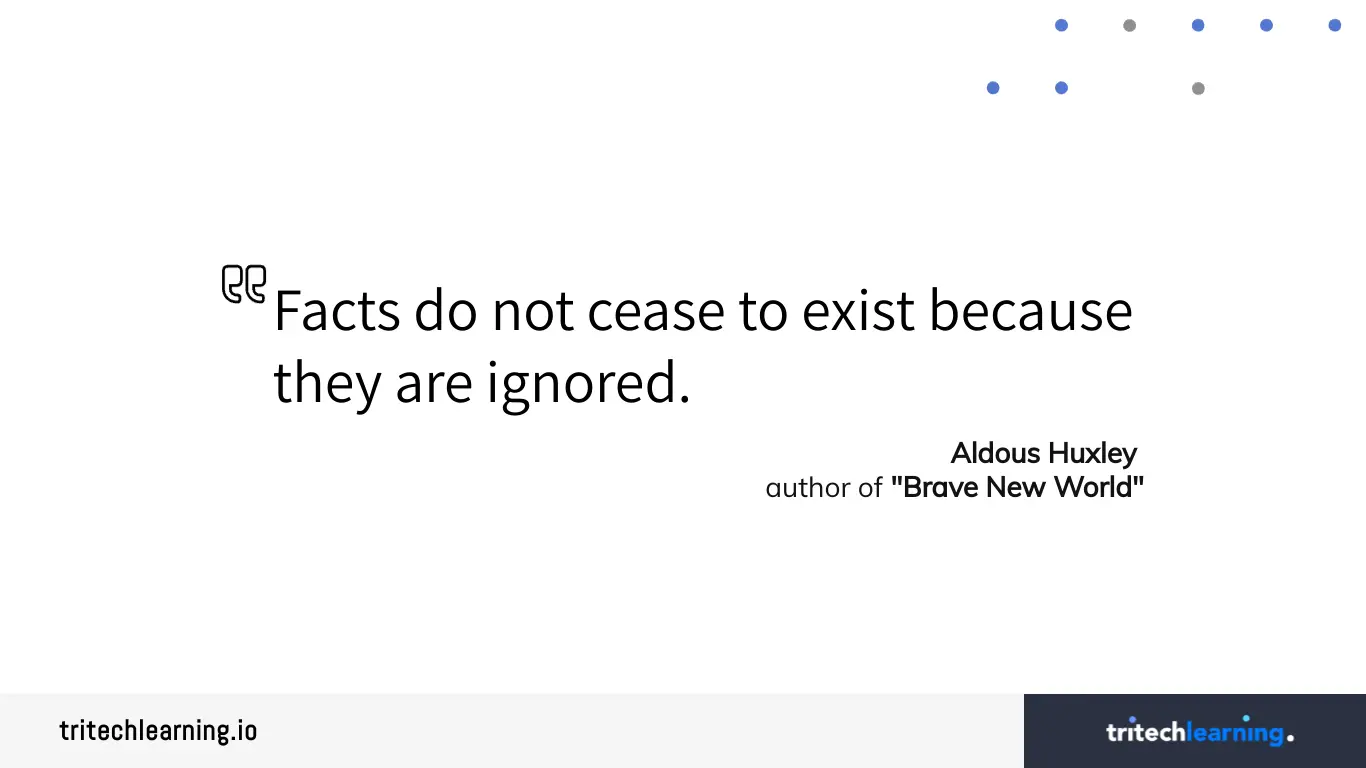
Facts Exist Even When Ignored
Confirmation bias is not just a mental hiccup. It can cloud judgment, deepen social divides, and lead to poor decisions. Learning to recognize and manage it gives us an edge. It sharpens our thinking, improves conversations, and helps us see things more clearly. As Huxley said, facts do not disappear when we ignore them. They remain, waiting to be seen.
Growth begins with curiosity! At Tri Tech Learning, you’ll find free courses, webinars, presentations and articles that help you understand yourself and grow with purpose. To advance even further, explore our premium courses, workshops, and 1-on-1 coaching sessions, each designed to turn insight into meaningful, lasting change.


 Self‑paced