

The Psychology of Self-Esteem: Building Confidence That Lasts
Am I Good Enough?
- As we move through life, most of us encounter moments when we ask, “What if I’m not good enough?”, even when we have accomplished much before. Studies show that many people struggle with low self-esteem, a subtle yet powerful factor shaping how we think, feel, and act (Rubino, 2012). Self-esteem refers to our personal evaluation of our own competence and value. It reflects beliefs such as “I am capable” or “I am not good at anything,” and emotions like pride or shame (Rosenberg, 1965). It influences how we interpret success and failure, how resiliently we recover from setbacks, and how we pursue our goals. Research consistently links healthy self-esteem to greater career achievement and stronger relationships, while low self-esteem is associated with depression and avoidance behaviors (Orth & Robins, 2022). In this article, we will explore how low self-esteem impacts life and how evidence-based strategies from the Knowing Yourself course can help strengthen it.
Self-Esteem’s Lifelong Journey
- Self-esteem develops across our lifespan and evolves through experience. It forms in early childhood through warmth and positive feedback, dips during adolescence under peer and body-image pressures, and often stabilizes in adulthood before gently declining later in life (Robins & Trzesniewski, 2005). Think back to adolescence, when comparisons and social approval felt all-important. That period often leaves lasting traces in how we evaluate ourselves. Low self-esteem formed early can persist into adulthood, shaping confidence, decision-making, and even health outcomes. Recognizing this developmental path helps us work consciously to rebuild it.
Social Media’s Toll
- Social media has intensified social comparison. A 2025 study found that 70% of young adults felt worse about themselves after scrolling through idealized content (Vogel et al., 2025). The curated perfection we see online can distort how we judge our competence, looks, or social standing. Unlike task confidence, self-esteem reflects how we evaluate ourselves globally. When this internal sense of competence is shaped by external approval, we become more vulnerable to anxiety, perfectionism, and avoidance.
Academic and Professional Struggles
- Self-esteem influences how persistently we engage with challenges. Students with fragile self-esteem often avoid difficult subjects or projects, fearing that mistakes will “prove” incompetence. This avoidance can lead to underperformance, reinforcing negative self-beliefs. In adulthood, the same pattern plays out in career development. Employees with low self-esteem may hesitate to speak up, propose ideas, or pursue promotions. When self-esteem depends on flawless outcomes, learning and growth feel threatening instead of motivating.
Mental Health Risks
- Low self-esteem is both a consequence and a driver of mental health issues. A 2023 study found that adolescents with low self-esteem had a 30% higher risk of depression and a 40% increase in suicidal ideation (Bergström et al., 2023). This connection stems from how we interpret failure and rejection. When self-esteem is low, we see setbacks as reflections of who we are rather than as events that can be overcome. Over time, this leads to avoidance, dependence on external reassurance, and diminished motivation.
How to Strengthen Self-Esteem
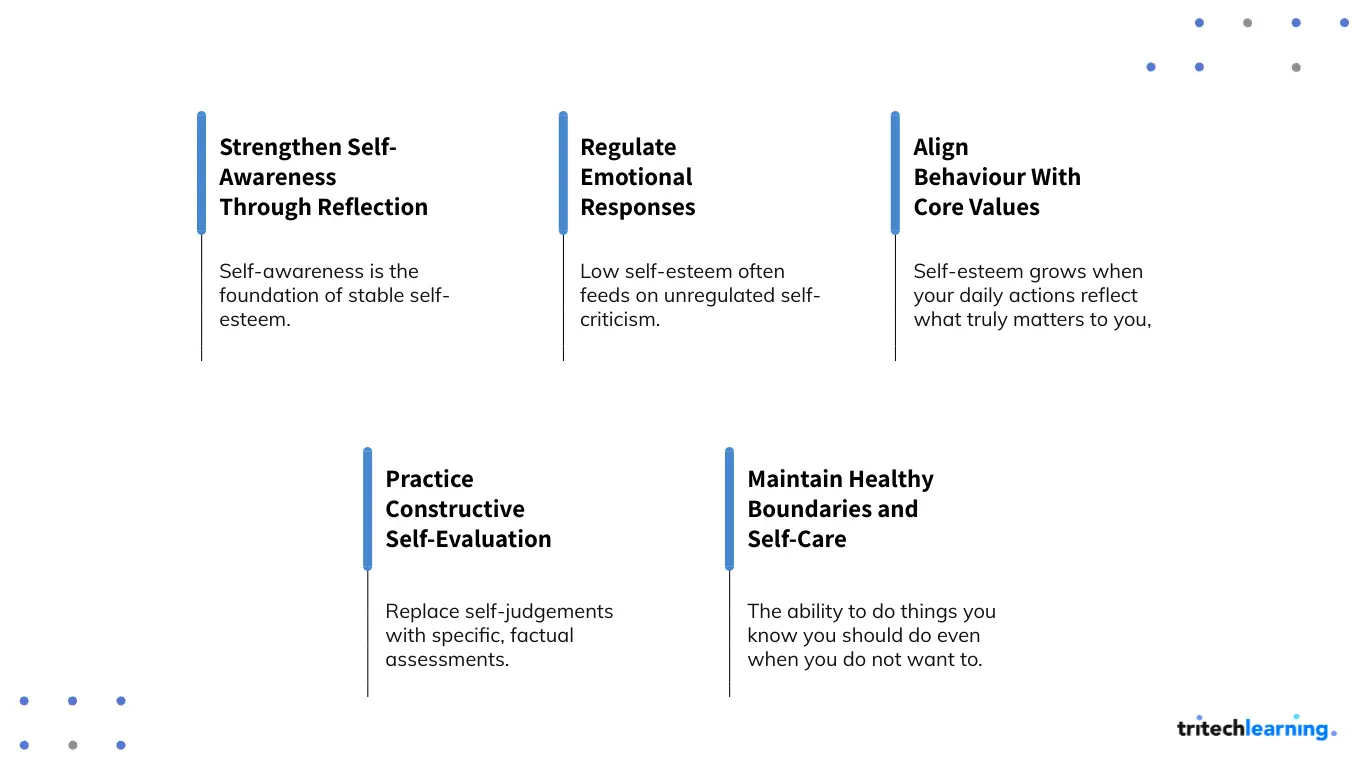 Self-Esteem Strategies
- Improving self-esteem begins with building awareness, emotional regulation, and alignment between identity and action. Below are five strategies derived from the course’s evidence-based methods. Strengthen Self-Awareness Through Reflection Self-awareness is the foundation of stable self-esteem. Journaling about your emotions, values, and reactions helps you identify triggers that erode confidence and recognize authentic strengths. Writing down what went well each day (even small wins) reinforces a realistic sense of competence. Regulate Emotional Responses Low self-esteem often feeds on unregulated self-criticism. Practicing emotional regulation techniques such as pausing before reacting, labeling emotions, and reframing self-talk creates balance. This skill enables you to manage disappointment and avoid interpreting every mistake as a personal failure. Align Behavior With Core Values Self-esteem grows when your daily actions reflect what truly matters to you. Acting in accordance with your values (such as honesty, responsibility, or growth) reinforces internal validation and decreases dependence on others’ approval. Practice Constructive Self-Evaluation Replace perfectionistic or global self-judgments (“I always fail”) with specific, factual assessments (“I missed a deadline this time, but I met the last three”). This approach teaches the distinction between competence feedback (skills that can improve) and identity judgments (which are unhelpful). The more precise the reflection, the stronger the self-esteem. Maintain Healthy Boundaries and Self-Care Self-esteem thrives when we treat ourselves as valuable. Setting limits, resting, and saying no when necessary are not selfish acts but affirmations of self-respect. Consistent small acts of self-care and assertive communication gradually reshape your internal sense of worthiness.
- Self-esteem is not vanity; it is the psychological foundation of confidence, learning, and resilience. When fragile, it distorts how we interpret challenges. When stable, it allows us to face mistakes without losing motivation. The encouraging news is that self-esteem can be strengthened through reflection, regulation, alignment, and care. These practices are not quick fixes but habits that reshape how you perceive yourself. Even a few minutes of mindful reflection each day can begin restoring a sense of competence and calm.
- If you want to deepen your self-discovery and build a strong foundation for personal growth, consider our course “Knowing Yourself: The Key to a Fulfilled Life” It offers clear guidance, reflective tools, and practical exercises to help you understand yourself and grow with purpose and confidence.
Growth begins with curiosity! At Tri Tech Learning, you’ll find free courses, webinars, presentations and articles that help you understand yourself and grow with purpose. To advance even further, explore our premium courses, workshops, and 1-on-1 coaching sessions, each designed to turn insight into meaningful, lasting change.
 Self‑paced
Efficient Learning: Master the Science of Learning
Efficient Learning: Master the Science of Learning is a course designed to explain how memory works, show how to use cognitive psychology to improve focus, and build habits that make learning practical, effective, and lasting.
€0€99
 Self‑paced
Knowing Yourself: The Key to A Fulfilled Life
Knowing Yourself: The Key to A Fulfilled Life is a psychology-based course that helps you build self-esteem, strengthen self-worth, and gain clarity about your identity, emotions, and personal growth.
€399
 Self‑paced
Emotional Intelligence: For Growth in Love, Work, and Life
Emotional Intelligence: For Growth in Love, Work, and Life will help you understand emotions, build empathy, and strengthen relationships with practical, research-based emotional intelligence skills.
€499